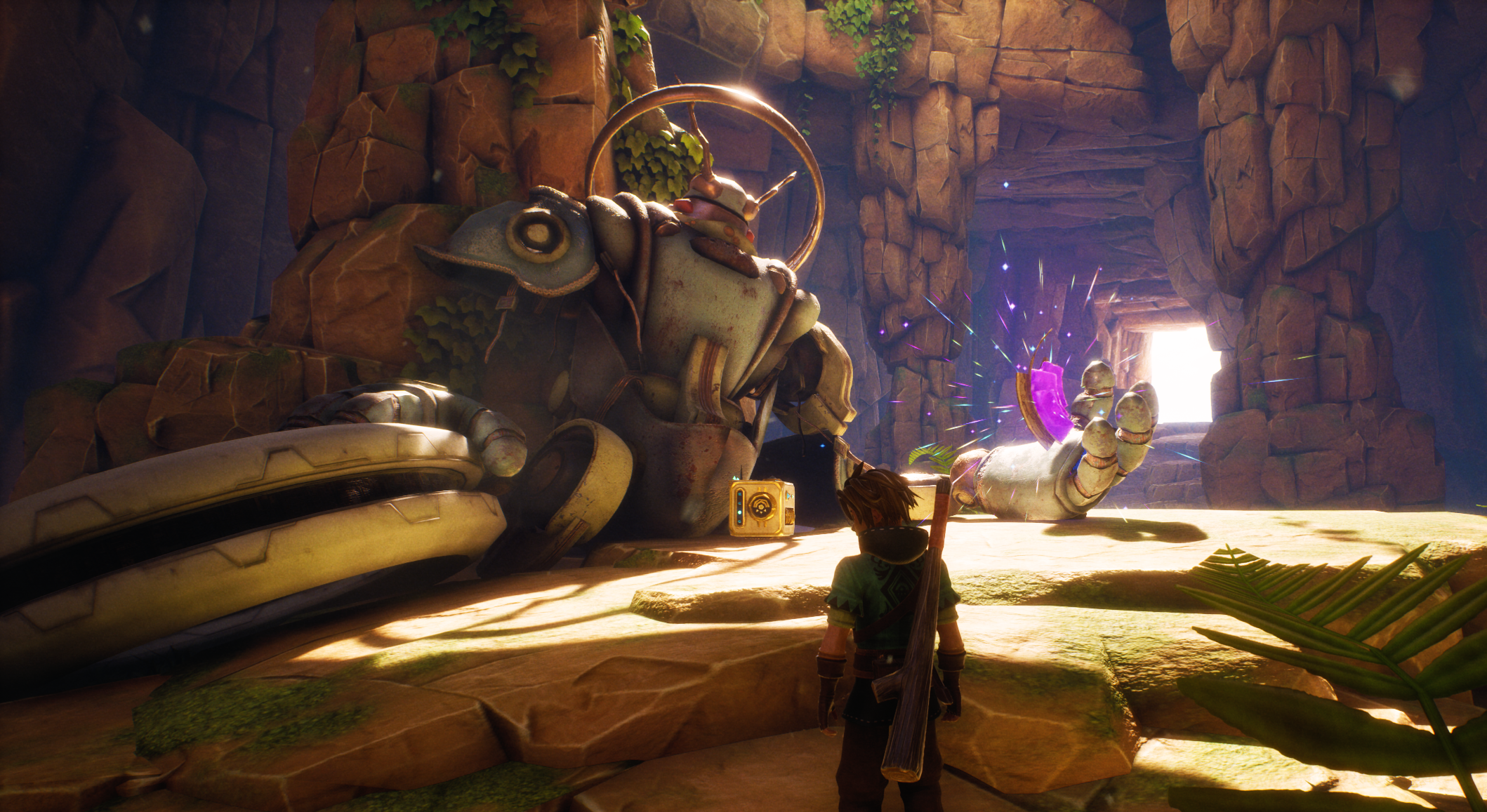
I didn’t know Wamo was going to change everything.
I got the audition sides and read the character brief: *”Wamo is an ancient deity. A jester among Titans. He is diminutive in size, but colossal in character.”*
Okay. A jester. Chaotic, whimsical, probably a little unhinged. I figured I knew what I was walking into.
Then I read the lines.
—
*”It’s time I say goodbye to this cruel, godless world. So, as my final recording… a brief history of the settlement of Gaia.”*
*”Perhaps you’ll find me one day floating on an ocean breeze. Or see me in the glimmer of a wave. Or hear me in the song of the sea. If you do, remember my story and believe it. We tried our best.”*
—
That’s not a jester. That’s a man at the end of the world, hitting record one last time.
Wamo is an ancient deity who has been dead for a very long time. What you find in the game are his recordings — audio and hologram — left behind for whoever comes next. This particular recording is one of his last. Maybe the last.
And what does he do with it? He doesn’t panic. He doesn’t rage. He doesn’t go on a coke-filled bender while the world burns around him. He archives his knowledge. He thinks about the people who come after him, not himself.
That’s not a jester. That’s a scholar. That’s the smartest guy in the room choosing to spend his final moments making sure his story survives him.
I thought about the “jester” spec and put it aside. Sure, maybe on a good day Wamo puts a bucket over a door and laughs about it. But this isn’t a good day. It’s his last day. And what front do you put up when your life is ending?
None. There’s no front. It’s the end of the world and you chose to put others before yourself.
So I didn’t perform Wamo. I found him.
I asked myself one question: what would I do if I was literally watching the world end and decided to hit record one last time?
I grounded myself in that place. I didn’t think about *how* I’d say the lines. I just said them. I lost myself in the moment. I watched the world die. I kept my composure and archived my story for the people who would come next. And then I reached the end of the recording — the part where you’ve said everything you had to say, and somehow there’s still everything left to say.
*We tried our best.*
Wamo loses his composure here. He doesn’t cry. But he knows this is it. He gets a little sad. He wavers. And that’s it. No big fight. No villain speech. No “you’ll rue the day you messed with Wamo.” Just a man at peace with what comes next — but still not afraid to be afraid.
I said it. I hit stop. And when I came out of it, it felt like I walked back into the room.
*Was that acting? Because that felt pretty damn good.*
—
I wanted more of that. And that’s when things clicked.
It stopped being about jumping through hoops and finding a way to sound real. It became about empathizing with these characters. Walking a mile in their shoes. Finding the place where their story and my story overlap — and painting that intersection in a way that other people could see it too.
I stopped caring about the money, or the fame, or any of it. I cared about more chances to do *that*. To use my experiences, my loves, my pains, my wins and losses, and everything else I’ve carried — to see the world through a character’s eyes and embrace their struggles, their grief, their joy, and use my own life to portray theirs.
To move people, by moving myself first.
Yeah, I know. That all sounds pretty heavy for a two-page character in a video game.
But Wamo was the first time I tasted what acting actually is. And once you taste it, you can’t go back to just performing. I saw why I do all the other jobs — the commercials, the narrations, the stuff that keeps the lights on. It’s so I can live long enough to do jobs like this one. To learn something true about myself and share it with whoever’s listening.
It became about the art.
—
Oceanhorn 3: Legend of the Shadow Sea is out now on Apple Arcade. Go find Wamo. You’ll know the moment when you get there.